|
Richard Rose read this "lecture" of questions
as part of a few public talks he gave. Its effect can be very powerful if you
listen to someone reading it. KOAN SECTION What do you know for sure??? Does a man own a house or does the house own him? Does a man have power or is he overpowered? A predator or a victim? Or both? Does a man enjoy or is he consumed? Does a man really reason … or is he so programmed? Can a man learn … that which he really wishes to … by himself alone? Can a man become? How shall he know what he should become? * Why build ant hills before knowing what an ant is? (Houses.) Why do we build conceptual Towers of Babel about human thinking … before we know that which thought is? How can we dare to define thought before knowing the source or cause of all thought? Or the essence of thought? When we describe bouncing … do you describe the striking object or that which is struck? Is thought the process of bouncing or the object struck? (Everything struck reacts with an opposite, equal force.) Can you start thinking? Can you stop thinking? Is thought something received or something projected? (Meaning all thoughts.) Is thought a sort of somatic emanation? Do we think, or are we caused (forced) to think? Is negative thinking (as commonly discussed) negative to man or negative to nature? Does the brain generate thought like a radio generates the message coming from its speakers? Is thought limited to the brain? When a tree bends over does it create wind by waving its branches? (I.e., what are you doing for certain and what is done to you?) What is telepathy? Does thought travel beyond the head? Does only the head think? What is the vehicle for thought-travel? Does the body manufacture thoughts, or does the body only serve as a conduit? Where in the body are thoughts received during telepathy? Where are they sent? Do chemicals such as serotonin and other neurotransmitters create thought – or do they merely facilitate the penetration into our consciousness, – of strictly sensory data? Where will the answer to this question lead us? (Multi-dimensional contacts?) How many full hours do we spend analyzing our thought processes? Is it important to so observe our reactions? Are we only a body? In what part of that body is the seat of life? We can cut off an arm, or leg, or cut out and replace lungs, heart, kidneys, and still live. We can have our nervous system severed at the neck, with paralysis except in the head – and still live and think. We can remain unconscious for years while the body continues to live, noting that a person who is brain dead according to medical instruments, – can continue to live, breathe and at times recover and function consciously.
Is our thinking automatic? Do not our thoughts come before we have time to replace them? When we decide to search for the source of thought – why do we become mentally weary, or find our thoughts becoming able to find objective or describable distractions, but unable to describe, name or systematize the progression, origins or duration of thought processes? Is man only a blob of protoplasm which is programmed to react according to a schedule, or is he a free agent? (Conditioned reflexes.) Are thoughts likewise only reflexes from programmed or calculated stimuli? Who programmed? Who stimulated? What is Thought? Can we observe our thoughts? If we observe our thoughts, who is looking? When we observe our thoughts are we not thinking about thinking? Is such a thinker someone who dreams of yesterday, thinking that he watches a dreamer, – or is he a detached watcher of past and present thoughts who is awake and aware of the mechanical man? What are we? An animated body, and a suppressed, stagnated soul? Do we have a mind, are we mind-stuff, or are we a programmed body and mind? Do we actually know that which we are doing? If so why do we repeatedly regret things that we do? Does the metazoan, insect, animal or man know why it reproduces? Do the trees create wind by waving their branches, or is it always moved by an external force? Does a person seduce another or are both seduced? What does man do besides fertilize? Are you a hero or a victim? Are you loved, or are you consumed? Do you have possessions – or are you possessed by them? Which is more evidential and apparent to you, your divinity or your animal appearance? If we wish to plan our lives, do we not need to consider while planning that it may be all planned, and that we have no choice? How do we plan around that possibility? Must we not define our limitations? When we define our limitations do we automatically need to define our self? Do we discover, more accurately, the nature of our self? How much of human action is fated, – predestined? Is the knowledge of factors of any value in the face of possible predestination? What do you know for sure? Do you believe more than you really know? Is all of our Reality merely a collective belief? A paradigm? (Joseph Chilton Pearce.) Is science a mental feat created by mankind, or is it only a human discovery of a mental set? Or is scientific reality only a progression of events planned and expedited by a mentality of cosmic or spiritual proportions, which utilize the mentality, egos, and energy of humans? What is life? What is death? Are these items ever properly defined except in terms of each other? Can theological facts be established by voting? Is Mary the mother of God or is humanity the mother of God? Or Neither? Is God determined by victorious armies? Is virtue established by psychological edict? By ecclesiastical vote? Or by the requisites of our ultimate essence? What is sin? An offense against yourself…? An offense against your fellow man…? An offense against God…? Is an offense against God recognized by divine outcry … earthquake or cosmic catastrophe? Is it a sin to eat meat? Are the animals our brothers? Are they possessed of intelligence and soul? Do animals sin when they eat other animals? Or are such sinning animals pardoned for keeping ecology in balance? Is it wrong to kill except for food? If so, do we do wrong by not eating the people we kill? * Who is knowledgeable about good, the item goodness? Is good that which we desire … or that which is in itself good? What is the condition of "being good in itself"? Is evil the child of good … or is it a twin? If a man drives a horse through a plate glass window, should the man be prosecuted … or the horse? If a man steals to feed his children … should we prosecute the man, or that which drove him, – the children? If a man rapes a girl, should be prosecute…
What is equality? Was Samson equal to Delilah? Is a baby equal to a dying man? Are you only half of a plan by virtue of not possessing both sexes? Is peace of mind more important than global peace or herd peace?
Are you a body? Are you rather a complex organism? A cell colony … a nature-oriented bundle of conditioned reflexes? Is the brain a monitoring station designed for the organism's indefinite survival? Or is our body programmed for death (death gene) following procreation? (Like the corn and wheat.) Is all religion and philosophy merely rationalization emanating from that computer … to answer constant cellular awareness of death? Or is the universal belief in life after death an intuitive reading from that computer? A reading not completely translatable into computer symbols which are limited? Is there a soul? Did it exist before the body or must it be developed, grown, or evolved? Prove the following: Mind (as other than somatic awareness); sub-conscious mind; ego; id; superego; chakra, kundalini; tisra-til; astral; etheric; causal; desire; body; aura; halo; ectoplasm; spiritual ear; conscience; spiritual nectar. What is time? Does time pass or is it only you who passes? Is space-time a stable matrix while we are only transient visitors? How much of life is only a mirage? Do we see this world infallibly or obliquely? Are the senses infallible? Can you see, or hear, or feel, or smell or taste time? Is time only a relative conceptualization? What is the reality of time? Does the ant or amoeba interpret duration the same as man or does its time pass more swiftly? What is duration? What does a lifetime feel like? Does it feel differently to a child and to an old person? What is the relation of memory to time? Do we remember a "duration" or measure it if we have no clock at hand. Do we remember how long a pain lasted when the pain occurred a year ago? Would women become pregnant as often if they remembered the duration and intensity of the pain of childbirth? Do we have a real sense of time when we hear a clock ticking? Do we then know what a second is, or what stretch of consciousness exists for others in that second? Do the wings of the hummingbird move rapid or slow to the gauging of the hummingbird? To the time-sense of the fruit fly is his life long or short? Is the sense of duration or "passing time" proportional to the mass of the entity that experiences? Does time exist other than as a fascination which seems to be brief or longer duration? If the sun is our ultimate clock (of earth-rotation as measurement), what is our measurement of time after the death of our senses? Is time an illusion that prevents us from experiencing a Self that has no motion? Have you ever heard a clock ticking in a delirium? |
If the mind can be distorted in a delirium or in an LSD trip – does the mind ever understand the true feeling of a second? What is nostalgia? Is it the soul's view of previous feeling? What is space? Is space interdependent with time? Are they not measured by each other? (Light year. Time is determined by spatial phenomena, rotation-duration.) Do space and time exist at all except in reference to us? (What is the understanding by insects of the distance to the sun or moon?) Do we have a true picture of nature? * When we appreciate nature as being beautiful, is such an appreciation of life or of death? Have you ever watched the war that goes on in a drop of water or in a cancerous tissue? How many protozoans are eaten every second? How many microscopic metazoans are eaten each second by larger metazoans? Is death painless for these beings? Do they scream? How many small metazoans are needed to feed one worm for a day, or one insect? How many worms or insects die every minute to feed the birds? How many worms or insects are needed for one hen's egg? In the summer we hear the hum of many insects. Is this hum beautiful, – orchestral, or a bedlam of screaming? Are the songs of birds more than just mating noises? Are not trees more attractive in the autumn when dying? Which is the true destiny of all beings, – a growth into individual-eminence or a means of energy (food) for higher beings – meaning predators. THEOLOGICAL SECTION Should self-definition have priority over concerns for health? Is the idea of personal immortality, before such an idea has been proven by experiencing immortality, any more than an egotistical idea?
Should the search for God have precedence over using an unidentified divinity as a healing utility? Is God a gigantic gestalt? Why are we here? Are we accidents of evolution – animals that accidentally evolved upon a planet that accidentally evolved? The chances of accidental evolution seem unlikely in view of the complexities of protoplasm, such as the ability of the cell to produce millivoltage-components and to possess memory. Can we say all this came about by an immediate or instantaneous teleological prompting which had to take thousands of years to develop after the million years needed to evolve less specialized cells similar to plant-cells? How did neurotransmitters evolve? Were we created by very skillful bio-chemists? What is the process that would result in the evolution of synaptic voltage? Is life a dream – or an illusion? If so is it not a very detailed and consistent dream – showing few variations, – seeming to strictly adhere to a blueprint? Is man manufacturing this blueprint, by setting up a rough paradigm and creating details such as brain chemistry as he goes along? If so has man lost control of his creation, if he cannot find an alternate for disease and death? What are the odds for an accidental synthesis of a ketone enzyme? What is the significance of common denominators? Are they valid for evaluating religions and behavior? Is there a body-manufactured force, an Odyle, – Vril, – Élan vital, or Quantum energy capable of powerful and magical power, – transferable – and projectible? There are two windows, states of mind, which are not consistent with each other: They are the daytime view and the nighttime view. The latter with its dreams and horizontal speculations upon awakening forms a strange field of thought and threatens convictions of the daytime. How do we balance this force? What bearing do these (often morbid) night states of mind have on violent acts? Is there any value in speculating on the genesis of biological or human life, weighing the value and importance of slow evolvement against a possible perfect instantaneous creation, and weighing the suffering and dying against perfect or unchanging immortality? Are ecologists possibly trying to thwart the ordained directions of the engineer who designed the evolution of life? Sanity and syphilis – are they both decided by approval via democratic voting? If man did not cause himself, then that which caused him is invisible, meaning not apparent in this dimension. What reason would a superior engineer have for creating life as seen on earth – meaning flora and fauna. How rational are some of the reasons given for the acceptance of the creator concept and a set of morals presumed to gain tolerance from that creator? FINAL SECTION Why is talk (different perspectives) necessary? What causes different perspectives? What liabilities are incurred with unavoidable states of mind? What is a state of mind? Are perspectives rooted in valid bases and definitions or in indefinable feelings – which may be as valid or meaningful as definitions? Does a given color cause the same reaction in all people? Why do some perfumes enchant one person and cause nausea in another? What is beauty? How do perspectives which are influenced by feelings affect science? Do they help or hinder? Can a scientist totally rule feelings out of judgments? (Did the scientists of Columbus's time feel that the earth was flat or know that the earth was flat?)
Is it foolishness or wasted effort unless it is restricted to objective or materialistic values? Is all wisdom unbiased? Is a wise man just "one who gets along" with his fellow man? Is wisdom just adaptation, symbiosis, or a blending with others to a point of losing personal identity? Is silence a trademark of wisdom, – even if silence is caused by cowardice? Who or what is the "authority" in regard to human essence or nature? Does a man love or is he incapable of loving? Does not a man desire to be loved while pretending to love others? Does a tick love the host or the blood of the host? Is love of every kind programmed and projected into us? Is there only one dimension? Does not the possibility of multiple dimensions weaken our significance and our pretended potential for controlling our environment? What is God? What are his dimensions? What is a soul? Are these just aberrated ideas? Why do people use words like "God" or "soul" without going to some effort to define them? What is an idea? Is there a thinking self or only an awareness that witnesses reactions – and may possibly witness a pseudo-self or ego? Can a man have spiritual (or essence) clarity and be psychologically confused? Are we an individual or a conglomerate of several "selves"? If there is such a conglomerate, how is the Real Self isolated? Have we just now isolated the Real Self (by taking the position of external questioner)? Is thought a possession or an obsession? What is the relationship between thoughts and glands? What is sanity or insanity? Is sanity only somatic healthiness? Are unpopular people insane? (Or outside the normal curve?) Could sanity ever mean that state of mind with perfect understanding of all problems, a state of mind from which the altering lens of ego has been removed from mental vision or perception? Would such a version of sanity imply the need of perfected logic or perfected intuition? 
What is intuition? How does one arrive at it? Is thought a synaptic reaction to an electrical stimulus? If we cannot willfully think, – do we ever really make decisions? Or is it possible that only the people who realize they cannot enforce decisions – are the ones that eventually find ways or means to make things happen? If we think about thought, is thought then objective and separate from the thinking self? Is thought an entity, or an emanation of sorts? Can sanity be gauged by logic? Is behavior considered normal by virtue of percentages of incidence? (Example of normal curve.) Is all such "normal" behavior always logically excusable? Is sanity a way of measuring the skill of survival? Or is sanity also involved in the skill of checking factors such as motivation, correct reasons for living, quality-control of morality, and the control, or evaluation, of environmental factors? Would our behavior be the same if we discovered, – by logical or even commonsense means, – that our environment was greater or less than we previously believed it to be? (More mind dimension. The sanest bird cannot outwit the rifle, much less higher technology by poisoning.) In other words would we behave the same way if we discovered beyond speculation that there was no life-after-death? Or that our environment included other, perhaps endless dimensions? How would we react to the incontrovertible discovery of an inescapable immortality? Are we not caught somewhere between, and is not this materialism a bit of fence-riding that says on one hand that we can accept only that which we see, while refusing to look, or see, new factors not immediately accessible to our senses, or new truths which would give new definitions of life, and new meaning to existence? Psychiatry contains opinions rather than pure scientific finding. Is psychology becoming a cult? Does psychology or psychotherapy rule by edict rather than reason? Is there any science in the modus operandi of these current mental-therapies? Is it safe to allow psychologists to monitor our lives – if they are only cognizant of body-survival, and would program us only for that? Are psychologists who work in advertising and promotion a boon to mankind – or are they manipulators without proper respect for the victims of selfish, or spurious interests? Can the psychiatrist produce sanity in a person if he has not adequately defined sanity? If he defines sanity should he (the psychiatrist) not be required to bring sanity to every patient who is in any degree insane? What does behaviorism prove? What do the tracks made by an animal prove? Do they tell you about the essence or purpose of that animal? Does a normal curve define normality and morality? If 51 percent of the people become killers, will that make killing normal? Can we study the mind by ignoring brain chemistry, and [by] behavioristic testing? (Introspection / structuralists.) Is it more important to know what a
man is thinking, or capable of doing, than it is to know who it is that
is thinking or doing, and what is thought? Are the conclusions reached by introspective thinking corroborated by sciences such as brain chemistry and the statistics of behaviorism? Note: Does not introspection take in behavior? Should the behaviorists not take into consideration or at least not ignore the nature of mental behavior, and the multiple unseen causes of behavior, such as the meaning of life (which is the origin of thought) and the purpose for the existence of individuals? 
Unless the thoughts of first causes and the purpose of mankind is understood, fatalism would be as good a theory as any other, which would make behavioristic control efforts absurd. Is the photon an intelligent messenger of God? Is the photon a distraction-being that dazzles the human eye so that he cannot see the realities found in introspection? Will you ever be free and at the same time aware? * From Profound Writings, East & West © 1988 by the TAT Foundation |
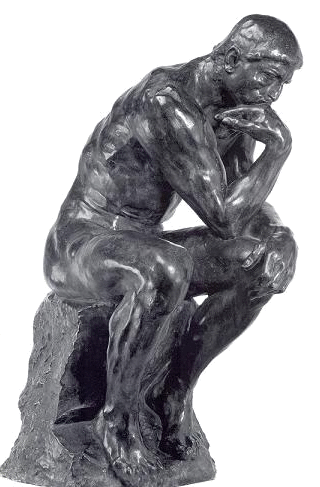 Do we think or imagine that we
think?
Do we think or imagine that we
think? Who or what are you?
 What are the mechanics of divine healing?
 What is wisdom?
|
For many years it has been the desire of the members of the TAT Foundation to compile a book that brings into focus the great esoteric and philosophic writings of history, and of the peescnt day. We have learned, from feed-back from our books, lectures and Chautauquas, that most sincere searchers never hear of some of these valuable works until after decades of active enquiry. And even after they have heard of the titles, they often find them difficult to obtain, because books are published and advertised proportionately to the demand for them. The demand for esoteric books may always be far below the demand for others, and among esotericists there are many disciplines and philosophies which ignore all that are not related to their own disposition or level. To find the gems of great thinking, a person may have to read scholarly works that comprise three or four hundred pages. For instance, Evans-Wentz compiled a book called Tibetan Yoga and Secret Doctrines. In its 360 pages we find mostly instructions … about right living, about yogic history and attainable powers. Yet there are pages which catch the eye and mind because of their truths. Thus, the value of taking excerpts, by which the reader may be inspired to read the whole book, or at least to amplify his desire to search further. Another example is the Bhagavad Gita, excerpted in this book, which is itself an excerpt from the Mahabharata, an ancient Indian epic given in an historical style. Philosophically, it is a dissertation on action versus non-action. Esoterically, it is an instruction on "ego" as opposed to strong efforts on behalf of others, or along lines of previously accepted spiritual dedication. We cannot claim to have reviewed all books of wisdom. There are many in which we will find, perhaps, a single quotation that lights a candle in the mind, and each solitary candle advances hope, or self-assurance that real definition of the mysteries of life is possible. In this book we have tried to strike a balance between the wisdom of the East – India, Tibet and China – and the harder to find, but no less profound, enlightened thought of the West. For our eastern selections, the problem was less one of locating writings which point to the Great Self, than of selecting a few from the multitude in that tradition. Ramana Maharshi, the serene Indian sage of our own century, was an obvious choice, for his compassionate instruction directed to disciples struggling with the demands of modern life. The Book of the Golden Precepts was collected by Madam Helena Blavatsky, the 19th-century founder of Theosophy, from Tibetan Buddhist and pre-Buddhist sources. She has done the "selection" for us, creating a condensed guide to the deepest teachings of mankind. There is no more direct language describing the relation between the self and the Self – about man's relation to the Absolute Reality – than that of the Upanishads of India. The few pages included here can be your starting point for hours of meditation. From the source of the Ch'an (Zen) tradition comes the Platform Sutra of the Sixth Patriarch of Chinese Buddhism. Less explicit in his metaphysics than the earlier Indian and Tibetan authors, Hui-neng, the illiterate peasant who preserved the Buddha's teaching in the 7th century A.D., laid out a psychological approach to sudden enlightenment as "direct seeing of one's own original nature." When we look to the West, the problem is not an over-abundance of mystical works; here, it has always been necessary to "read between the lines" to identify the philosophers, saints and poets who achieved – and sought to express – Hui-neng's "direct seeing" of Reality. This makes it appropriate to include two westerners who do not represent any particular religion or movement, but who have created their own, unique modes of expression to explain the inexplicable Mystery. The Hound of Heaven, by Francis Thompson, is one of the greatest accounts ever written about man's contact with the transcendent. It does not teach or engage in religious or philosophic argument. It describes the hell that precedes realization, and Thompson's intense emotional description becomes both teacher and revelation. He confers a relentless definition of the Real Self of man. Richard Rose, born in 1917 in West Virginia, launched himself into a spiritual odyssey in his youth. After studying the world's religions, and examining innumerable cults, all of which he found lacking, he underwent a spontaneous enlightenment experience at the age of 30, which he attempted to explain in The Three Books of the Absolute. This long poem, which Rose has said was written "automatically," moves in a relentless, almost frightening cadence, as it describes the gradual dissolution of the ego, and the pain of loss which precedes the experience of – or transformation into – Ultimate Reality. Rose's mystical elegy to the transience of earthly man was originally published in The Albigen Papers, his thoroughly practical guide to the spiritual search. The flavor of his skeptical, psychological approach can be seen in his Lecture of Questions where, by an accumulation of conundrums, he takes the reader (or listener) to the limits of conceptual thinking, and points to the Thoughtless Answer beyond. * Books by Richard Rose:
In addition to Amazon.com, ebay.com and BookFinder.com are good sources of new and used books.
© 2000-2026. All rights reserved. | Back to Top |